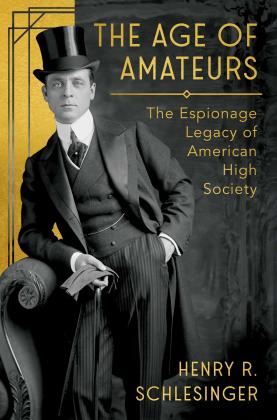
| Format | Hardcover |
| Publication Date | 12/01/26 |
| ISBN | 9798897102266 |
| Trim Size / Pages | 6 x 9 in / 352 |
This fascinating history of the intersection of espionage and high society reveals how it shaped American intelligence for two centuries.
The gentleman spy was a well-worn literary trope long before James Bond appeared on the printed page or silver screen. Yet, like many cliches, there is an element of truth to it. American espionage once relied on well-heeled amateurs to a very large degree. They possessed the necessary skill sets and unique expertise for the job. Espionage, the most pragmatic of occupations, requires language skills, knowledge of foreign nations, and, above all, access to those with access to secrets. A name like Vanderbilt, Astor, or Rockefeller opened doors. Others had long standing business relationships and friendships in foreign nations to smooth any inquiries.
There was Vincent Astor, who put the resources of his vast fortune at the disposal of American and British intelligence alongside the hundreds of members of the New York Yacht Club who donated their yachts to use as troop carriers and armed escorts. Then there was the socialite who saved thousands of lives as a honey trap codebreakder as well as Virginia Hall, the "limping lady" the Gestapo deemed one of the Allie's most dangerous spies. What motivated these people who truly had everything? Perhaps it was patriotism or a desire to prove themselves. Perhaps it was boredom. Espionage is many things. Dull is not one of them.
Yet whatever the motivations of the monied class, what Nathan Hale termed a "peculiar service" before undertaking his ill-fated mission has always attracted more than its share of unlikely and colorful characters. And those recruited from the ranks of the Social Register are no exception. They included dandies and debutantes, heiresses and do-gooders, explorers and the wildly eccentric. The Age of Amateurs is a surprising and skillfully told history of these adventures in espionage.
Henry R. Schlesinger is an author and journalist who has covered intelligence technologies, counterterrorism, and law enforcement. He is the co-author Spycraft and other books on espionage, and his articles have appeared in Popular Science, Popular Mechanics, Technology Review, and Smithsonian magazine. He lives in New York City.
Buy it now in print:
Buy it now in ebook:
"A lively and entertaining look at the gentleman spy, showing the evolution of spycraft from amateur to professional." Booklist
“American bluebloods were, argues Schlesinger, predestined to become spies—their Ivy League educations, aptitude for languages, and propensity for world travel gave them an edge in covert operations. An affectionate tribute to the bluebloods who once dominated American espionage.” Kirkus Reviews
“Schlesinger recaps American espionage from the 1882 establishment of the Office of Naval Intelligence to the WWII exploits of the OSS, which became a repository of upper-crust spies, saboteurs, propagandists, and insurgents. A glamorous era of secret-agenting.” Publishers Weekly
"Henry R. Schlesinger shines light on a superbly entertaining, hidden history of American espionage. The Age of Amateurs is a witty portrait of socialites, adventurers, and eccentrics who turned their privilege and networks into much more." Katie Sanders, journalist and co-author of Ortiz's War: The Allies' Secret Weapon Against the Nazis in France
"It often seems that today’s intelligence officers are painted in shades of gray. However, Henry R. Schlesinger takes us back to an earlier time when, for better or worse, American intelligence officers were painted in vivid colors. A charming and fascinating read. Some of the rich and famous people in this book made great contributions to American intelligence. Others were irretrievably feckless. All receive vivid and delightful tellings of their stories in The Age of Amateurs." Mark Stout, former intelligence officer, former historian at the International Spy Museum and author of World War I and the Foundations of American Intelligence
“In this fascinating and meticulously researched book, Henry R. Schlesinger charts the origins of what would become the CIA at a time when the United States was morally opposed to foreign intelligence gathering – ‘Gentlemen do not read each other’s mail’ – forcing Washington to rely on a patchwork of volunteer spies drawn from high society, with the addition of few lower-class recruits trained in the dark arts of espionage by the less fastidious British. Read this book to find out how the monied families that filled the gossip columns used their foreign contacts to fill the intelligence deficit.” Alan Philps, author of The Red Hotel and The Kremlin
“Before the bureaucratization of espionage, American intelligence was dominated by a swashbuckling patrician elite. In a stylish and perceptive volume, Henry R. Schlesinger brings to life the daring-do of Astors, Roosevelts, Vanderbilts, and their friends—gentleman amateurs who used their yachts, clubs, and bank accounts to get the better of America’s adversaries.” Michael Knox Beran, author of Wasps: The Splendors and Miseries of an American Aristocracy