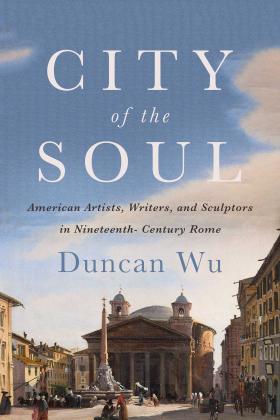
| Format | Hardcover |
| Publication Date | 05/04/27 |
| ISBN | 9798897103973 |
| Trim Size / Pages | 6 x 9 in / 400 |
Taking readers into the heart of Rome in the nineteenth and early twentieth centuries, this is the story of the remarkable expatriate writers and artists who transformed the city into a profound cultural and social mecca.
City of the Soul takes the reader to the heart of Rome in the nineteenth and early twentieth centuries. This story evokes the Rome of a one hundred-year period, a busy American colony full of clubs, societies, pensiones, cafés, restaurants, and libraries. It traces the intersecting lives—creative and personal—of these remarkable men and women, showing how their love of Keats turned Rome into a profound cultural and social mecca.
This is the Rome of Edith Wharton, Henry James, Axel Munthe, Elihu Vedder, William Wetmore Story, Thomas Cole, Frederic Edwin Church, William Makepeace Thackeray, Robert Browning, Elizabeth Barrett Browning, Arthur Hugh Clough, Louisa May Alcott, Harriet Beecher Stowe, Joaquin Miller, Henry Wadsworth Longfellow, Franz Liszt, Margaret Fuller, George Inness, Augustus St Gaudens, and Oscar Wilde.
For all of them, Rome was inextricably entwined with the memory of John Keats, the young English poet who died in 1821 in a small room beside the Spanish Steps and the Piazza di Spagna. And they were attracted to Rome in part by the knowledge that he ended his days there.
It begins with Keats's death and concludes a century later with F. Scott Fitzgerald completing The Great Gatsby a few minutes’ walk from the house where Keats died. Between those events, it traces the lives of some of the greatest artists and writers of the fin de siècle, showing how they were shaped and affected by a love of poetry.
Duncan Wu is a Raymond A. Wagner Professor in Literary Studies at Georgetown University. He is an acknowledged authority on Romanticism and the world's leading authority on the life and work of William Hazlitt. He is the author of twenty-two books, including the widely used textbook Romanticism: An Anthology (Blackwell, now in its third edition); Hazlitt: The First Modern Man; The New Writings of William Hazlitt; and Wordsworth's Poets. Dog-eared: Poems About Humanity’s Best Friend was published by Basic Books in 2020, and his poetry collection Origin Myths was published in 2024. He lives in McLean, Virginia.
Buy it now in print:
Buy it now in ebook:
Praise for Duncan Wu’s Dog-Eared: Poems About Humanity's Best Friend:
"The dog poems he's assembled here—so many of them little-known, so many of them revelations-testify to the fact that humans, from Homer to Dorothy Parker to Michael Ondaatje, have been trying to capture the essential nature of their canine companions for centuries, while dogs had us humans figured out long ago." Maureen Corrigan, book critic, NPR's Fresh Air
"Duncan Wu has curated a collection of poems that conjure both the pleasures of great poetry and the delights that dogs bring. Each poem invites us to consider the relationship between humans and animals and what it tells us about ourselves." Aminatte Forma, author of Happiness
"Dogs have held a special place in the hearts of men and women for as long humans have been humans. Duncan Wu has collected the best of these sentiments across history into a remarkable collection, proving that dogs are, and always have been, our best friends." Gregory Berns, author of What It's Like to Be a Dog
Praise for Hazlitt: The First Modern Man:
"Wu’s book is fun to read. Coleridge, Wordsworth, Lamb, Leigh Hunt slide in and out of the narrative, sniping, complaining, gossiping, but, most of all, thinking. If Wu errs, it’s on the side of enthusiasm. He doesn’t even feign disinterest. None of the new Hazlittians do.” Arthur Krystal, The New Yorker
"Wu is an Oxford academic whiz-kid (recently transplanted to Georgetown University) who by his early twenties had produced a stack of publications that would probably have taken a truck to transport; this impressively learned biography is the product of several years’ devoted toil. Every nook and cranny of Hazlitt’s career is meticulously recorded, from his attempts to stay out of debtors’ prison to his tempestuous love-life.” Terry Eagleton, Harper's MAgazina
"Wu is finely attuned to his subject’s qualities and sympathetic to the many personal, professional and religious struggles that so complicated Hazlitt’s tumultuous life.” The Atlantic
"Wu’s aims have been to restore Hazlitt’s significance while bringing much new information to the table about him. His success has been in wearing his scholarship lightly and producing a much-needed, concise, clear and readable account of the life and achievements of a most complex individual.” Sarah Burton, The Independent
"Wu, perhaps the leading Hazlitt scholar in the world, portrays Hazlitt as the great bare-knuckles, no-holds-barred prose fighter of the Romantic era. A distinctly eye-opening biography for anyone who knows William Hazlitt principally as an essayist.” Michael Dirda, The Washington Post
‘Wu rightly takes to be fundamental to our own age. There may be better books on Hazlitt, but none that offers us so direct an experience of the writer’s actual life.” Saul Rosenberg, The Wall Street Journal
"Duncan Wu’s new biography is a monumental achievement [which] brings Hazlitt and the members of his circle vividly to life.” Alfred A. Markley, The Eighteenth-Century Intelligencer